


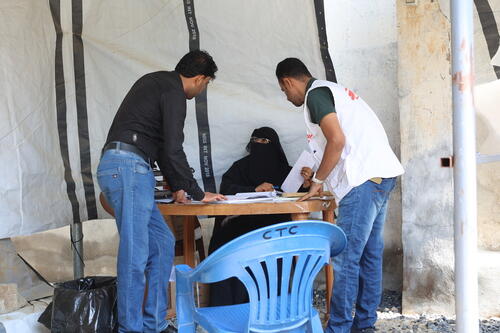
- MSF teams have witnessed a 65 per cent increase in acute watery diarrhoea cases in Hodeidah and Hajjah governorates, Yemen, in just one week.
- We call on international and regional donors and humanitarian organisations to scale up their support to prevent a worsening crisis.
Sana'a - Médecins Sans Frontières (MSF) is witnessing a sharp rise in acute watery diarrhoea cases in Hodeidah and Hajjah governorates in Yemen. In just one week from 7 September, the cases have increased by 65 per cent, amid worsening humanitarian conditions in the country. MSF calls on humanitarian organisations to urgently step in and direct funding to strengthen the response to this life-threatening disease.
Since the beginning of September compared to last month, the number of cases has doubled to above 400 patients at Abs General hospital in Hajjah governorate. Al-Qanawis hospital, Hodeidah, reported a weekly average of more than 21 patients, which is a 50 per cent increase in cases; many of them are children under five.
To cope with the surge, MSF, in collaboration with the Ministry of Health, opened a 50-bed diarrhoea treatment centre in Abs General hospital. This was later expanded to 75 beds and a 20-bed capacity centre was also opened in Al-Qanawis to support the increase of cases. The centres have treated a total of 4,493 patients of acute watery diarrhoea in both the governorates since the start of response in July.
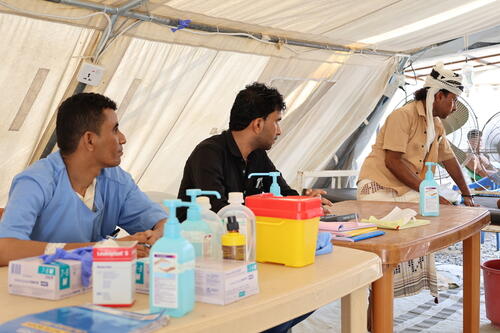
“Every day we are seeing more and more children arriving in severe condition, often with complications such as dehydration and malnutrition,” says Aziz Harouna, MSF medical coordinator in Yemen. “Our teams have expanded diarrhoea units in the two governorates to treat the cases and are implementing infection prevention and control measures to contain the spread of the disease.”
“The surge comes at a time when the country is already affected by the humanitarian aid cuts,” says Harouna.
MSF urges international and regional donors and humanitarian organisations to intervene, scale up their support and help prevent a worsening crisis.
Yemen’s crumbling infrastructure, years of protracted conflict, and lack of access to clean water and sanitation—compounded by recent heavy rains—have consistently fuelled the spread of waterborne diseases. Acute watery diarrhoea, a life-threatening condition if not treated promptly, poses a particularly grave risk to children under five. This latest spike comes on top of an already severe humanitarian crisis that continues to affect millions across the country.
Every day we are seeing more and more children arriving in severe condition, often with complications such as dehydration and malnutrition.Aziz Harouna, MSF medical coordinator in Yemen.
“When my daughter got sick, I took her to the clinic in our area, but her condition only got worse,” says Dosh Hadi, mother of Aima*. “I was so afraid to lose her. I then brought her to Abs hospital. The doctors are treating her, and she is feeling better now.”
“We have been displaced multiple times from one place to another and with no money it was difficult to travel here, but I am thankful the treatment is free,” she says.
MSF health promotion and community outreach teams are conducting individual and group sessions within hospitals for the caretakers of patients, visitors and communities, to raise awareness about the disease, its symptoms, and ways to prevent it.
Meanwhile, water, sanitation and hygiene teams are ensuring access to safe drinking water inside facilities and reinforcing infection prevention and control measures.
Acute watery diarrhoea is a deadly condition caused by the rapid loss of fluids and electrolytes through diarrhoea, which can lead to severe dehydration, kidney failure, and death if not treated promptly. The disease disproportionately affects children under five and other vulnerable groups. Timely treatment can save lives and prevent unnecessary deaths.
*name changed to protect patient's privacy.

Lebanon
Lebanon: Humanitarian scale-up urgently needed after almost two months of devastation
Statement
17 Apr 2026