


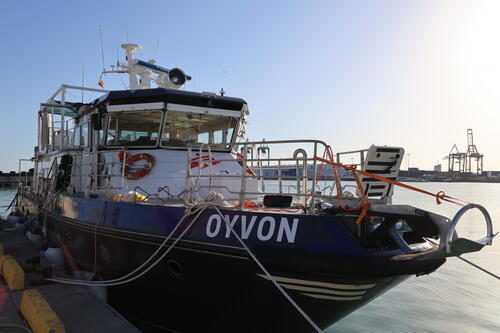
- Following our initial suspension of search and rescue activities in the central Mediterranean Sea, MSF is returning to help save lives on this dangerous migration route.
- Our new vessel, Oyvon, is smaller and faster to better respond to restrictive Italian policies around search and rescue activities.
Licata – Médecins Sans Frontières (MSF) announced today the relaunch of our lifesaving search and rescue activities in the central Mediterranean Sea, almost a year after being forced to terminate operations with our last rescue vessel, the Geo Barents.
Our new rescue vessel Oyvon, which means ‘hope for the island’ in Norwegian, has been refitted and equipped to conduct search and rescue operations in one of the world’s deadliest migration routes. Oyvon was previously operated as an ambulance vessel in Norway.
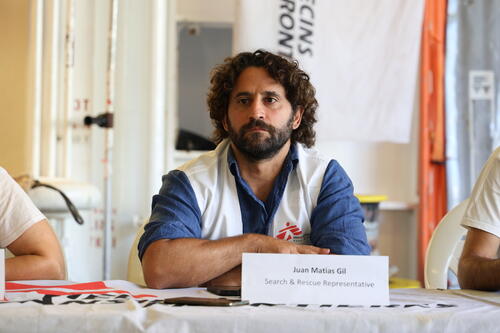
“As a medical and humanitarian organisation, our commitment to being present at sea and supporting people on the move is unwavering,” says Juan Matias Gil, MSF search and rescue representative. “We have returned to carry out the duty of rescuing those who find themselves in distress at sea, forced to take unseaworthy boats, after having endured deplorable and inhumane conditions, detention, abuse, and extortion, in Libya.”
Restrictive policies made search and rescue almost impossible
MSF was forced to halt rescue activities of the Geo Barents in December 2024, after more than two years of operating under restrictive Italian laws and policies, particularly the Piantedosi Decree and the distant port practice. These restrictive rules made operating the Geo Barents unfeasible; despite its capacity to sail with 700 people onboard, it was routinely directed to distant ports while carrying only around 50 survivors.
“MSF's decision to deploy a smaller, faster, vessel is a strategic response to the restrictive and obstructive laws and practice imposed by the Italian government, which specifically targets humanitarian rescue vessels,” adds Gil.
Juan Matias Gil, MSF search and rescue representative
“MSF's decision to deploy a smaller, faster, vessel is a strategic response to the restrictive and obstructive laws and practice imposed by the Italian government, which specifically targets humanitarian rescue vessels.”
By returning to the central Mediterranean, MSF also aims to report on and document the experiences of people who flee Libya, and collect their accounts of violent interceptions at sea at the hands of the Libyan Coast Guard and other actors. We will also document people's testimonies of forced return to Libya, which has been recognised as a violation of international maritime, human rights, and refugee law by Italian courts and UN bodies.
In recent months, there has been an increase in violent attacks in international waters by the Libyan Coast Guard and other armed groups against people crossing the Mediterranean, as well as against humanitarian rescue vessels.
The MSF crew onboard Oyvon includes a doctor and a nurse to provide medical care in life-threatening situations and treat people for hypothermia, fuel inhalation, and fuel burns, as well as wounds they might have sustained in the cycle of abuse and detention in Libya.
The central Mediterranean remains one of the deadliest migration routes globally, according to the International Organization for Migration, at least 25,630 men, women and children died or went missing on this stretch of the sea since 2014, including 1,810 in 2024 alone.* This means that five people died on average every day, making 2024 the second deadliest year on record since 2017, despite the observed decrease in departures.
MSF has been active and engaged in search and rescue activities in the central Mediterranean since 2015, working on nine different rescue vessels (alone or in partnership with other NGOs) and rescuing more than 94,200 people.
In January 2023, the Piantedosi Decree (Decree Law 1/2023) introduced a new set of rules in Italy, applicable exclusively to civilian rescue vessels, and a set of sanctions for non-compliance, ranging increasingly from 10 to 20 days of detention in port as confiscation of the vessel.
Since the implementation of the punitive Piantedosi Decree, the Geo Barents was sanctioned four times, amounting to 160 days of imposed detention. Between December 2022 and December 2024, the obstructive measures also forced the Geo Barents to cover 64,966 additional kilometres and spend an extra 163 days at sea to reach distant ports in the north of Italy for the disembarkation of survivors after rescue, rather than in closer ports in the south.
To receive regular and direct updates on MSF’s search and rescue operations, you can follow our social media accounts on X, BlueSky, WhatsApp, and Instagram. You can also visit our website.
Lebanon
Lebanon: Humanitarian scale-up urgently needed after almost two months of devastation
Statement
17 Apr 2026
Gaza-Israel war
Addressing frequently asked questions and allegations about MSF’s work in Gaza
Project Update
17 Apr 2026