


“It was between ten to 12 o'clock when my uncle’s wife went to bed,” says Kochai, a mother of five who survived the magnitude six earthquake that struck eastern Afghanistan on 31 August 2025. “I told her not to lock the door of the house, my senses saying an earthquake might happen. I was sitting on my bed later when there was a boom.”
“I jumped up to grab my two small children and then rocks started to come from every direction,” she says. “As soon as we stepped out of the door, the room behind collapsed. I couldn't do anything.”
As soon as we stepped out of the door, the room behind collapsed. I couldn't do anything.Kochai, a mother of five and earthquake survivor
“Many people have died, and my heart now feels blackened. I’m afraid to go back there,” says Kochai, who is from Shomash, a remote village in the Nurgal district of Kunar province, close to the earthquake epicentre.
The earthquake was one of the deadliest in Afghanistan in a decade, causing over 2,200 deaths and injuring over 3,000 people across four provinces, including Kunar and Nangarhar. Thousands of survivors have been displaced and are now living in temporary camps.
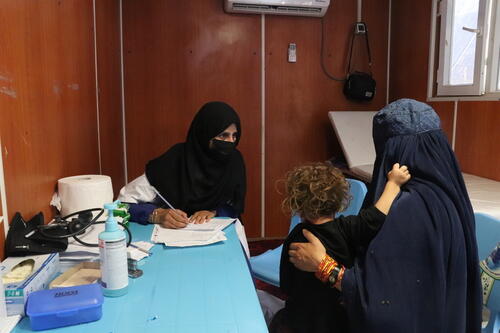
In the days after the disaster, Médecins Sans Frontières (MSF) sent donations of medical supplies to the three main hospitals in the affected area that were treating the injured. By early-September, MSF began running a basic 24-hour healthcare clinic, and a health post, in Patan camp in Kunar province. Since mid-October, a mobile clinic team has also been visiting displaced people living in Ari Gamba camp in Shomash village.
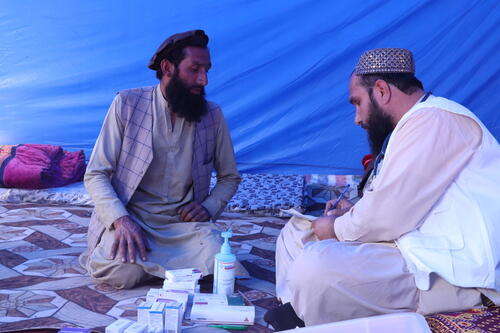
The teams offered trauma care in the immediate aftermath, and later outpatient consultations, vaccinations, antenatal and postnatal care, health promotion sessions, and individual mental health consultations.
Between mid-September and late-October MSF teams treated over 7,500 people, mainly for diarrhoea, upper respiratory tract infections, and skin diseases, including scabies – a reflection of the hardship of living in the camps. Men, women and children also come to the MSF clinic from other camps and nearby villages.
The aftermath of the earthquake
Patan and Ari Gamba camps are among several temporary settlements for earthquake-affected people in the Nurgal district of Kunar province, collectively sheltering an estimated 8,000 people who come from the most severely impacted villages.
“We are seeing that people from the earthquake-affected areas are suffering from hopelessness, they are depressed,” says Dr Nahida Noor, an MSF medical doctor. “A patient recently told me that she feels as if her daughter is appearing before her, as if her husband is sitting in front of her. That feeling exists in many people’s minds, who lost loved ones. And the sound of the earthquake and the destruction remain in their memory.”
We are seeing that people from the earthquake-affected areas are suffering from hopelessness, they are depressed.Dr Nahida Noor, an MSF medical doctor
MSF is providing individual counselling sessions and psychosocial support group sessions for affected communities, with nearly 250 people participating per week. Alongside the psychological consequences of losing family, friends, homes and belongings, the survivors of the earthquake will soon be faced with another challenge – winter. The nights are already cool, and soon the temperatures will drop below zero, and in some places, snow will set in.
“Winter is approaching this mountainous region, and it will snow,” says Sayed Jalal, one of the displaced people in Ari Gamba camp. “Living in these tents is not possible. Just the other day, there was light rain and hail, and our children and women suffered greatly.”
“Our bedding and belongings were all buried under the rubble,” says Jalal. “We were given a few blankets, but even those cannot withstand the cold. The tents also cannot resist the cold.”
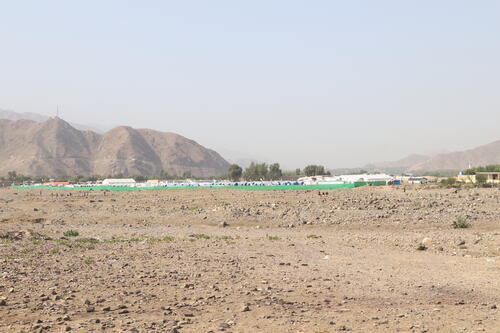
With the colder weather we are expecting an increase in seasonal illness, such as respiratory tract infections like pneumonia, and communicable diseases, such as measles and whooping cough. The people living in the camps have only temporary shelters without heating and electricity, and the area is ringed with mountains.
“More will need to be done to ensure that survivors can live comfortably until a permanent solution is found or until they can return home,” says Dr Esmatullah Esmat, MSF’s medical adviser in Kunar.
Lebanon
Lebanon: Humanitarian scale-up urgently needed after almost two months of devastation
Statement
17 Apr 2026