MENTAL HEALTH IN WAR, DISPLACEMENT AND MIGRATION _Ukraine
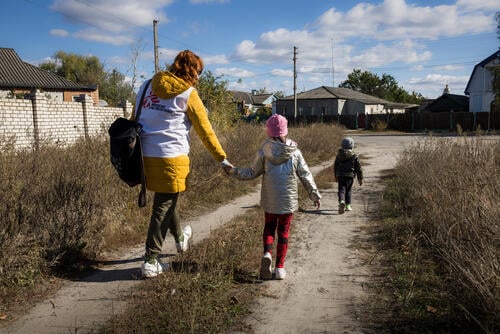
After therapy sessions, an MSF psychologist accompanies children to school. Ukraine, October 2023.
© Nuria Lopez Torres
As the war in Ukraine continues, our teams are responding to a humanitarian crisis. 

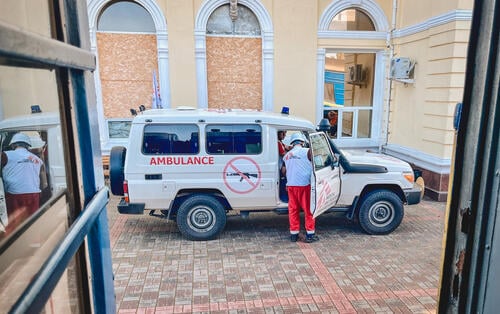
We provide medical care and psychological support to people who have been caught up in, or have been forced to flee, the fighting. Our teams provide vital training to hospital staff, while surgical teams provide lifesaving care and support in hospitals near the frontlines in eastern regions. Our activities also include medical evacuation of patients from hospitals close to the frontlines to hospitals in safer areas.

There is full-scale warfare in many areas, making movements difficult, dangerous or simply impossible. We are responding in various parts of the country, based on where our assistance is needed and will have a significant impact. 

Our activities in Ukraine in 2024

Data and information from the International Activity Report 2024.

MSF in Ukraine in 2024 In 2024, as the international armed conflict in Ukraine showed no sign of abating, Médecins Sans Frontières (MSF) increased support for people affected by the violence, by filling gaps in care.
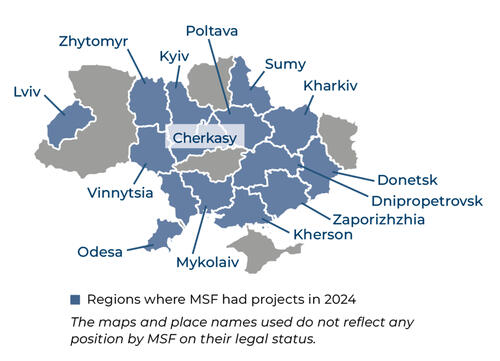
Ukraine IAR map 2024
Country map for the IAR 2024.
© MSF

MSF teams remained close to the frontline, delivering emergency medical treatment, while also expanding services in other regions to support long-term recovery, such as rehabilitation for trauma survivors, and mental health care.

As the war has evolved, we have adapted our response. In addition to providing essential trauma care in hospitals in Kherson, we ran mobile clinics and ambulance referrals in all regions along the frontline, which stretches for more than 1,000 kilometres. Our mobile teams screened for tuberculosis and offered treatment for chronic diseases, such as hypertension, mainly to elderly and vulnerable patients, many of whom had resorted to living in basements or shelters to escape the shelling. Our ambulances frequently responded in the aftermath of airstrikes, referring wounded patients to nearby hospitals.

In a shelter run by local organisations in Zernove, Kharkiv region, we offered psychological care to people who had moved from Russia and Russian-occupied regions of Ukraine. In Pavlohrad, our teams provided mental health and basic healthcare for people fleeing the encroaching fighting in Pokrovsk and Kurakhove, Donetsk region. However, in April, MSF’s office in Pokrovsk was destroyed by a missile. Five people were injured in the attack, including an MSF staff member.

We also increased our mental health activities in 2024. We focused on treating post-traumatic stress disorder at our dedicated centre in Vinnytsia, and established a professional and community network to deliver trauma care for displaced people. In 2024, we expanded our support to reach people who have endured prolonged exposure to traumatic experiences, helping them manage their symptoms.

In Cherkasy and Odesa, MSF’s rehabilitation services comprised physiotherapy, mental health care and nursing support for people who have recently had trauma surgery, including amputations.  

We continued to send professionals and medical supplies to hospitals near the frontline to provide training and resources for mass-casualty influxes.


in 2024