


“I came back to repair the damage to my house,” says Abdel Karim, his words almost drowned out by the hum of an Israeli drone overhead. “But without safety and the ability to afford basic things like medicines, how can anyone really start over?”
One year has passed since Israel escalated its war in Lebanon, but the humanitarian crisis is far from over. Despite the ceasefire agreement in November 2024, Israeli attacks are almost a daily reality, hindering people’s ability to recover and restricting their access to care. Israeli forces are still occupying several points along the southern border, preventing people’s return and leaving more than 82,000 displaced. 1
Attempting to rebuild
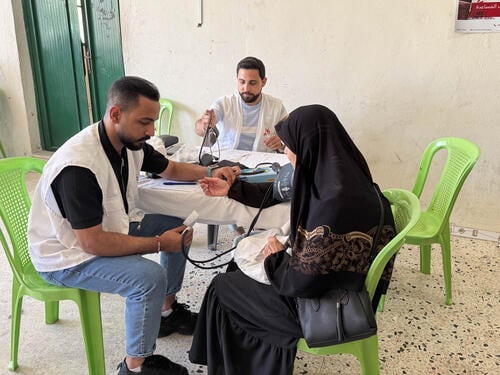
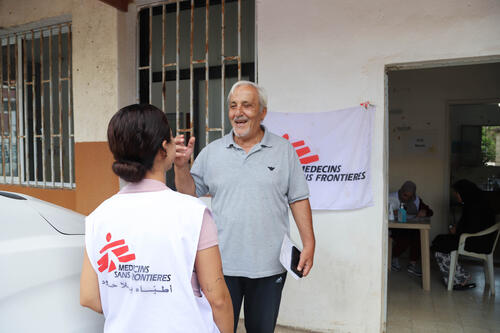
Abdel Karim returned to his town in Bint Jbeil district of the Nabatiyeh governorate – one of the hardest hit areas – where he now receives his chronic disease medications from a Médecins Sans Frontières (MSF) mobile clinic. Thousands of families across Lebanon struggle to access healthcare as they attempt to rebuild their lives amid or after displacement, loss, and uncertainty.
Video
Communities in Lebanon still face uncertainty
In southern Lebanon, war has devastated infrastructure, including healthcare facilities. At the height of the escalation, eight hospitals, mostly in the southern areas, were evacuated, while 21, or around 13 per cent of the country’s total were damaged, drastically reduced their services, or were forced to close. 2 Another 133 general healthcare facilities also shut their doors, and Nabatiyeh alone lost 40 per cent of its hospital capacity. Today, many damaged facilities remain closed, and many need rehabilitation.
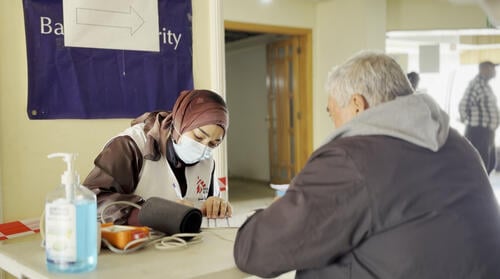
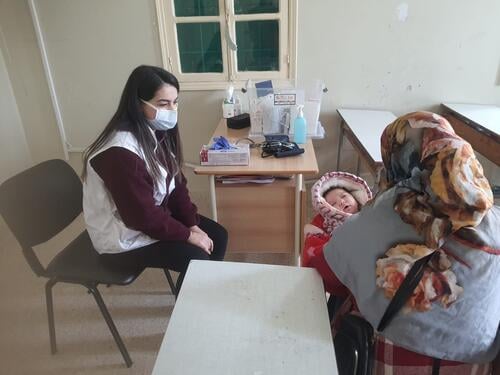
After the escalation, MSF set up new activities in the hardest-hit governorates—Nabatiyeh, the South, and Baalbek-Hermel, while maintaining our presence and provision of services in Beirut, Bekaa and the North. In the southern governorates, where available services remain financially out of reach for many returnees, we set up mobile clinics to ensure communities’ access to vital medical and mental health services. MSF is also rehabilitating and supporting three general healthcare centres.
Heavy burden
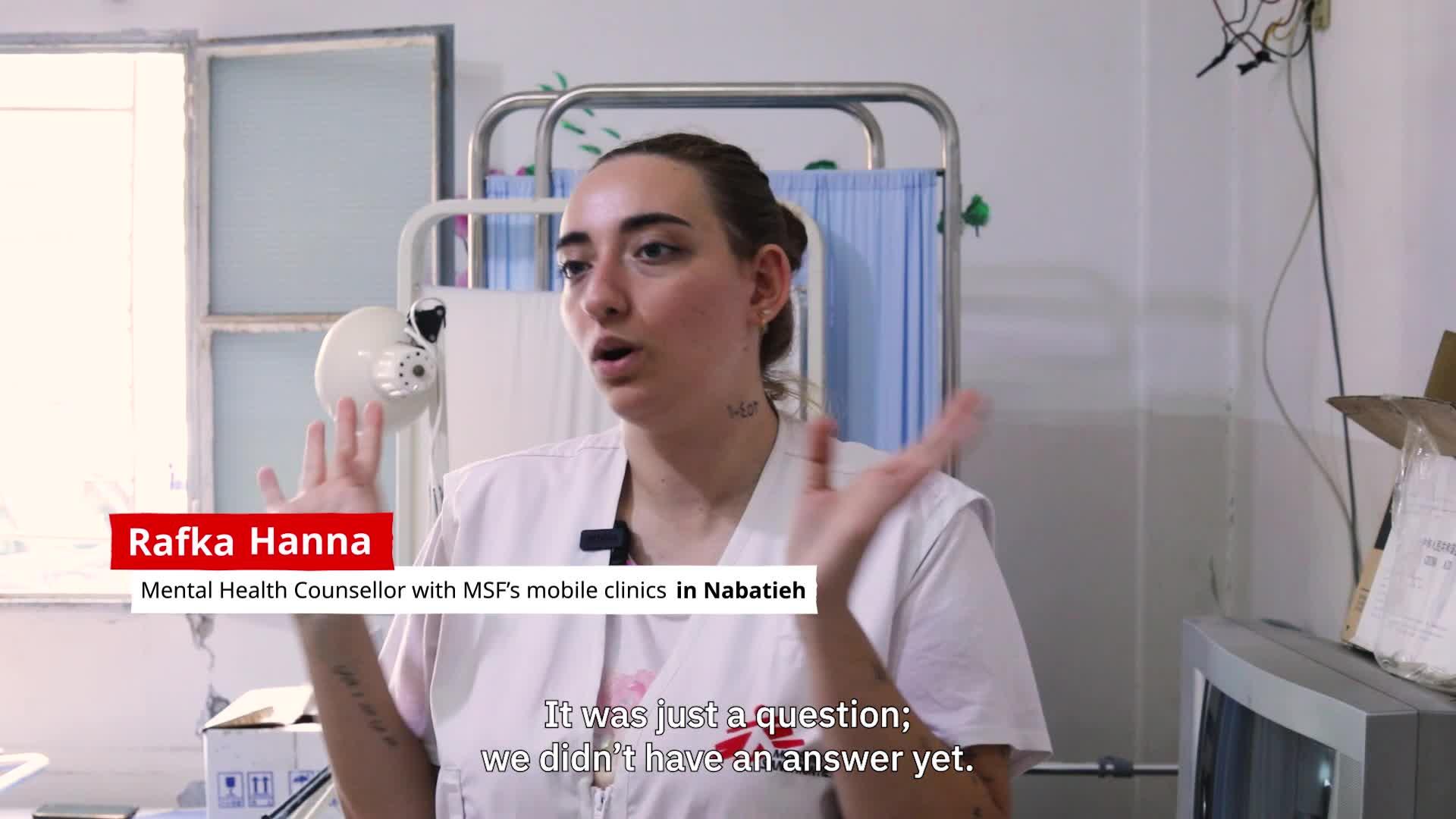
“Wars leave an immense toll on the communities that are directly impacted,” says Tharwat Saraeb, a psychologist with MSF’s mobile clinic in Nabatiyeh governorate. “Here, not a day goes by without people re-experiencing the devastation. Drone sounds, continued occupation of lands and non-stop airstrikes all deepen the suffering of people.”
Here, not a day goes by without people re-experiencing the devastation. Drone sounds, continued occupation of lands and non-stop airstrikes all deepen the suffering of people.Tharwat Saraeb, MSF psychologist in Nabatiyeh governorate
MSF teams on the ground continue to witness the human cost of the escalation and the lasting impacts of a war that has not fully abated. Many patients live in fear and uncertainty, many unable to begin recovery. Mental health needs are also profound, as children and adults alike experience stress, anxiety, and constant fear.
“My daughter faints at the sound of any strike, even if it’s far away,” says Samira, a patient of MSF’s mobile clinic. “She has a child of her own, and we all tremble with fear – it affects us all deeply."
A shared plight
The war devastated Lebanese families, refugees, and migrants. Lebanon is home to more than a million Syrian refugees, hundreds of thousands of Palestinians, and many migrants who already live in precarious conditions. These communities were excluded from many relief efforts during the escalation, despite facing the same urgent needs for food, shelter, and healthcare.
One year on, refugees’ and migrants’ needs are neglected. Their access to specialised healthcare through humanitarian organisations is at risk.
By the end of 2025, the UN Refugee Agency and the International Organization for Migration will cease covering specialised healthcare, while UNRWA and UNICEF face unprecedented funding cuts. The severe global funding cuts for humanitarian programmes leave enormous needs unmet.
For people like Abdel Karim and Samira, rebuilding their lives remains an uphill battle. MSF teams remain committed to providing services wherever they are needed, ensuring that communities are not left without access to vital healthcare. Yet true recovery will only be possible when people can live free from fear and can access the medical, mental health and essential services they so urgently need to start over.
Notes to editors
MSF currently works in seven governorates across Lebanon. In Beirut, we run two fixed clinics in Bourj Hammoud and Bourj El-Barajneh. In Baalbek-Hermel, we run two fixed clinics in Hermel and Arsal, and we operate three mobile clinics. In southern Lebanon, we run three mobile clinics in Nabatiyeh and support three general healthcare centres in the South. In the North, we support five general healthcare centres in Tripoli. In Bekaa and Akkar, we run a mobile clinic in each governorate.
Between 23 September 2024 and 1 September 2025, MSF provided or supported:
175,338 medical consultations
14,179 individual mental health consultations
12,433 group mental health consultations
Lebanon
Lebanon: Families face uncertainty under bombardment and new evacuation orders
Project Update
13 Mar 2026
War and conflict
MSF adapts and scales up activities amid escalating Middle East conflict
Press Release
5 Mar 2026