


Measles cases are rising rapidly across Central, South, and West Darfur, Sudan, in the absence of an urgent and effective vaccination campaign. More than 1,300 cases have been recorded since September 2025 in health facilities supported by Médecins Sans Frontières (MSF), despite our repeated advocacy for vaccination campaigns and the resumption of routine immunisation programmes.
We urge the authorities to immediately eliminate all bureaucratic and administrative barriers to transporting vaccines throughout Darfur. At the same time, there must be greater urgency from UNICEF to coordinate efforts to increase the transport and delivery of vaccines, syringes, and other necessary supplies. We also call on state and federal Ministries of Health to launch an urgent measles vaccination campaign and a routine immunisation programme.
“Measles is a preventable disease; it requires only routine immunisation and timely reactive vaccination. But due to conflict, administrative barriers, and delays by key agencies, both have been severely limited,” says Ahmed Fadel, MSF emergency coordinator in Darfur. “These delays are leaving vulnerable children exposed to a disease that is deadly.”
Measles is a preventable disease; it requires only routine immunisation and timely reactive vaccination.Ahmed Fadel, MSF emergency coordinator in Darfur
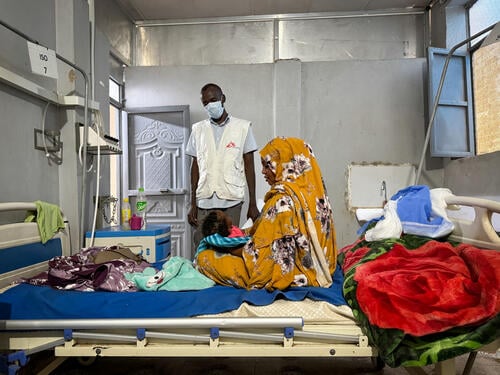
Ferdos Salih brought Banan, her 11-month-old baby, who has measles and severe acute malnutrition to El Geneina Teaching hospital in West Darfur.
“She was born prematurely because the war forced us to flee from Omdurman while I was pregnant,” says Salih. “She has suffered a lot with repeated hospitalisation. Also because of the war, she couldn't get vaccinated.”
Banan’s older brother got measles and there was not enough space for him to isolate in their home, which they share with two other families. This led to Banan’s infection.
Shipping vaccines for reactive campaigns and routine immunisation programmes takes place in a challenging operational environment in Sudan. Ongoing conflict has disrupted import routes and created significant administrative and bureaucratic hurdles for humanitarian organisations, including delays linked to authorisations for cross-border shipments.
At the same time, the delivery of vaccines, and the other supplies necessary to carry out vaccinations, are not coordinated efficiently, with shipments arriving at different locations and times. This creates another hurdle to overcome before vaccinations can start.
This is the main cause of delays... The supply of vaccines and related supplies must be better coordinated so that both arrive to where they are needed much more quickly.Ahmed Fadel, MSF emergency coordinator in Darfur
“This is the main cause of delays... The supply of vaccines and related supplies must be better coordinated so that both arrive to where they are needed much more quickly,” says Fadel.
At Zalingei hospital in Central Darfur, MSF teams have treated 1,093 measles patients so far in 2025, with a sharp increase in recent months: 78% of cases were recorded since September. In Nyala Teaching hospital in South Darfur, teams treated 242 measles patients during the year, 95% of them since September. Meanwhile, El Geneina Teaching hospital in West Darfur received 429 measles cases in 2025, with 59% reported between September and November.
Matara Abakar brought her ten-month-old son, Natrin, because he had been sick for 17 days with a fever, diarrhoea, a cough, and a skin rash. He is also severely malnourished.
“We are struggling to find jobs. I’m a farmer, and it's hard to earn enough money to buy proper food,” says Matara. “We depend only on asida [Sudanese food made with sorghum or millet flours].” She has two more children who are also not fully vaccinated.
More than 34 per cent of patients in Zalingei and Nyala are also acutely malnourished, which increases the severity of measles and rapidly leads to life-threatening complications, including pneumonia and encephalitis. Delays in vaccine shipments, and repeated postponements of a reactive vaccination campaign, are leaving children unprotected while the outbreak continues to expand.
More than 29% of cases in Zalingei and 34% in Nyala were in children over five years old, highlighting the longstanding failure to ensure routine immunisation in the region, even before the the current conflict. Consequently, the response to these outbreaks should include children aged between six months and 15 years.
Insufficient vaccination campaigns
Six months ago, in June, large-scale vaccination campaigns were carried out in the Jabel Marra region of Central Darfur. However, they did not extend to Zalingei, nor to South or West Darfur, where MSF teams are now witnessing the sharp rise in cases. At that time, we warned that these campaigns would only have a short-term impact. While some efforts have been made to bring in vaccines and other necessary supplies, like syringes and disinfectant, a mass vaccination campaign and scale up of routine vaccinations are urgently needed to stop the spread of measles.
Between November 2024 and May 2025, MSF teams carried out four vaccination campaigns in response to measles outbreaks:
- In November 2024, our teams vaccinated 9,600 children in North Jebel Marra;
- In February 2025, MSF conducted a measles response in Jebel Marra, South Darfur, treating 5,909 patients and vaccinating 36,209 children;
- Between December 2024 and May 2025, our teams vaccinated more than 79,000 children in Rokero, North Jebel Marra. After the end of the campaign there was a reduction of measles cases by 96.5 per cent;
- In April, MSF teams vaccinated more than 54,000 children in Foro Baranga, West Darfur.
MSF teams in Darfur are also treating patients with diphtheria, pertussis, and other vaccine-preventable diseases.
“What is urgently needed now is for the Ministry of Health — with the support of health partners, including UNICEF — to resume routine immunisation and ensure sufficient vaccine supplies,” says Fadel. “Countless lives could be saved, yet after more than two and a half years of war, the world continues to fail the people of Sudan.”
Conflict in Sudan
Strike on Al‑Jabalain hospital results in 10 fatalities, including seven medical staff
Voices from the Field
2 Apr 2026
Conflict in Sudan
MSF report finds there are no safe places for women and girls in Darfur
Press Release
31 Mar 2026