Arsal - Cholera outbreak in Lebanon
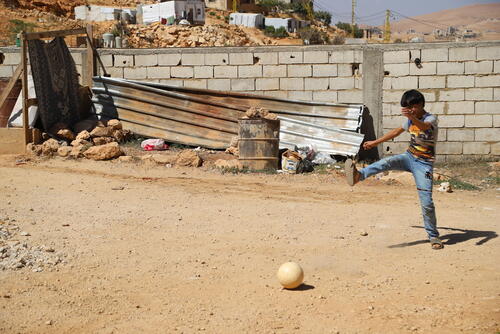
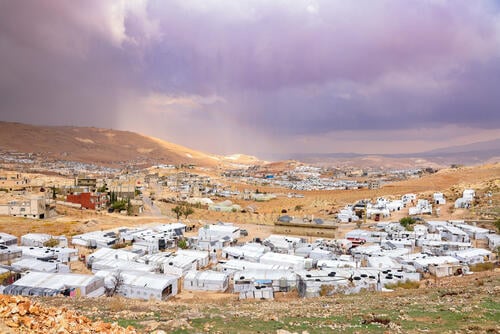
An aerial view of Arsal, Bekaa Valley. Lebanon, November 2022. 
© Carmen Yahchouchi
The Lebanese health system struggles to provide basic services as the ongoing economic crisis and political unrest have left more than 80 per cent of people residing in Lebanon below the poverty line and in dire need of assistance.

Access to healthcare in the country is threatened by the pressure on the deteriorating public services on top of the soaring prices of private healthcare. Lebanon hosts more than 1.5 million Syrian and Palestinian refugees, in addition to approximately 250,000 migrant workers.  

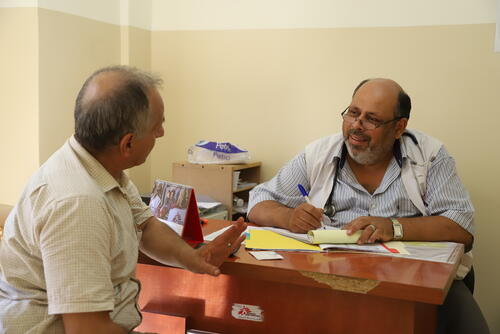
We have adapted our services in the past years to provide free, quality healthcare to many communities, including Lebanese people. We run and support health facilities in six governorates, providing general, paediatric, reproductive, and mental healthcare, as well as treatment for non-communicable disease, vaccinations, and health promotion. 

Our activities in 2024 in Lebanon

Data and information from the International Activity Report 2024.

MSF in Lebanon in 2024 Médecins Sans Frontières (MSF) expanded activities in Lebanon following the intensification of Israeli bombardments and ground incursions in September 2024.
Lebanon IAR map 2024
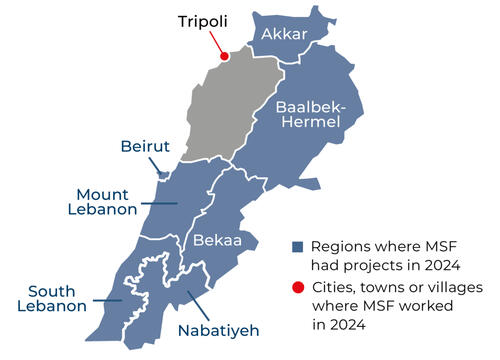
Country map for the IAR 2024.
© MSF

The war in Lebanon erupted amid an ongoing economic crisis, in which people were already struggling to obtain medical care. In 2024, one million people were displaced from their homes, while two million required urgent humanitarian aid.

MSF has been active across Lebanon since 1976, running clinics providing treatment for non-communicable diseases, paediatric and reproductive healthcare, and mental health services. From September 2024, we scaled up our activities to respond to the needs of people affected by the war.  

In Tripoli, we covered treatment costs for non-communicable diseases at external clinics, trained medical staff, and donated medicines. In Beirut’s southern suburbs, our clinics in Bourj Al-Barajneh and Bourj Hammoud provided reproductive healthcare, mental health support, and general consultations to the local community, including Palestinian and Syrian refugees, as well as migrant workers from sub-Saharan Africa and southeast Asia.

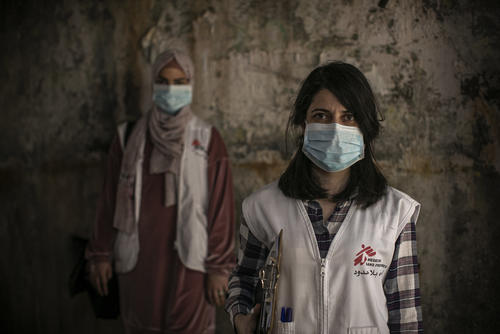
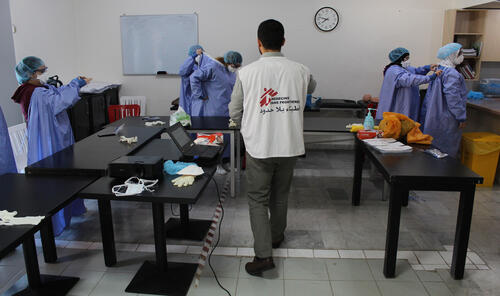
By mid-2024, we had integrated reproductive and mental health services into Al-Makassed healthcare centre in Wadi Khaled. In Baalbek-Hermel, we offered basic and reproductive healthcare, treatment for chronic diseases, and mental health support through clinics in Arsal and Hermel. We also facilitated emergency referrals for specialised care. In August, we partnered with Lebanon’s Ministry of Public Health to conduct a cholera vaccination campaign in Arsal, focusing on overcrowded refugee communities.

Following the escalation in Israeli bombardments and ground incursions in September, MSF sent 22 mobile medical teams to heavily affected areas, including Beirut, Mount Lebanon, Baalbek-Hermel, and Akkar, to deliver trauma care and mental health services and support healthcare centres. We strengthened hospitals’ capacity by conducting mass-casualty training and supplying tonnes of medical and relief materials.  

In Saida, we supported the Turkish hospital by donating medical supplies and assisting the surgical team. We also launched a telephone helpline to offer remote mental health support. These efforts were crucial, as health facilities were unable to cope with the rising number of casualties and the destruction of their infrastructure.  

In addition to these medical activities, we distributed hygiene kits, blankets, mattresses, and water to shelters for displaced people, and supplied hot meals for hundreds of families during the months of war.  

After the November ceasefire, many displaced people returned to destroyed homes. Others were too afraid to return. Access to healthcare remains extremely limited, due to widespread damage to infrastructure and unaffordable costs. The war has been particularly devastating for healthcare staff and facilities. The World Health Organization reported that 226 health workers and patients were killed, and 199 injured, between 7 October 2023 and 18 November 2024.[1]

At the end of 2024, we continued to provide vital medical care and support to communities facing ongoing economic hardship and insecurity.


in 2024

Contact us

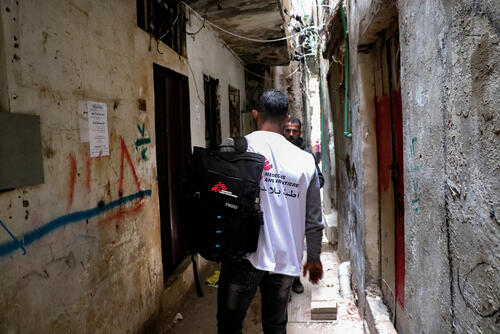
Shatila Camp
MSF Lebanon

Hamra main street, Domtex building, 5th floor
Beirut, Lebanon
Area zip code: 1103