Emergency intervention against Cholera Comoros

Comoros

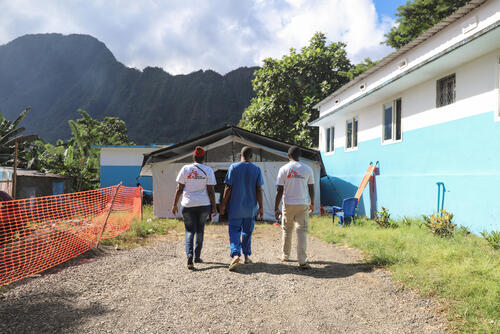
Nurse activity managers walk toward an oral rehydration point in Anjouan, in the locality of Tsembehou. June 2024, Comoros.
© Nisma Leboul/MSF

We closed our project in Comoros in July 2024.

In Comoros, MSF responded to a cholera outbreak from February to July 2024.

MSF opened a project in Comoros after the government declared a cholera outbreak on 2 February 2024. Comoros has experienced cholera epidemics since 1975, but this outbreak saw over 10,000 people contract the disease.

Our teams supported treatment centres with supervision and trainings, contributed to a mass vaccination campaign, and assisted in community engagement for prevention. With the outbreak contained, the project closed in July 2024.

Our activities in 2024 in Comoros

Data and information from the International Activity Report 2024.

MSF in Comoros in 2024 Médecins Sans Frontières (MSF) teams worked in Comoros, a country consisting of three main islands in the Indian Ocean, for the first time in 2024.
Comoros IAR map 2024
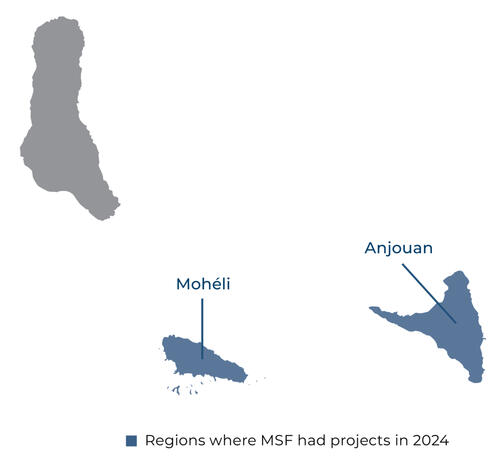
Country map for the IAR 2024.
© MSF

Following the declaration of a cholera outbreak in February 2024, MSF responded on Anjouan and Mohéli islands by supporting the Ministry of Health’s cholera response. We focused on improving care, infection prevention and control measures, and facility patient flow, through staff training and facility upgrades.

MSF also expanded the treatment capacity in several facilities, for example increasing the number of beds in Hombo cholera treatment centre from 23 to 47 beds, and in Domoni treatment centre, from eight to 27 beds. In addition, we collaborated with UNICEF and the Comoros Red Crescent, in coordination with the International Federation of Red Cross and Red Crescent Societies, to decentralise care, by establishing one mobile and six fixed oral rehydration points on Anjouan, and improve patient stabilisation and referral systems. 

As well as helping to strengthen patient care and improve the organisation of health facilities, we supported the Ministry of Health by conducting vaccination campaigns with the oral cholera vaccine on both islands.

By mid-July, as cholera cases declined, the rehydration points were reintegrated into health centres. We concluded our activities that month, after making a final donation of medical supplies and training staff to maintain cholera response capacity.