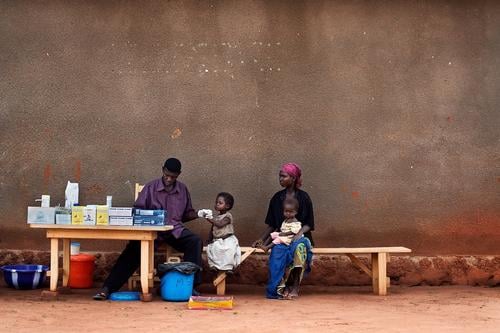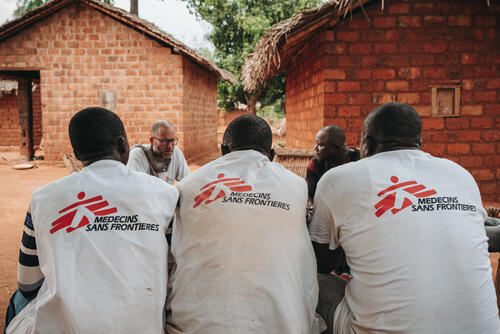
Thousands of people have been killed or wounded and millions displaced during years of bloody – but largely neglected – conflict in the Central African Republic.
Since the civil war of 2013, CAR has been marked by cycles of intensive violence. Fighting between the government and non-state armed groups, spurred by an election process, escalated in early 2021.
MSF sees the direct consequences of violence on the health of individuals and entire communities. There is a severe lack of access to healthcare; trained health workers are scarce, health services are poorly resourced and often targeted by the conflict; and patients need to travel hundreds of kilometres on dangerous roads to reach medical structures.
In CAR, we focus on treating victims and survivors of sexual violence; provide sexual and reproductive healthcare, including maternal healthcare; and provide treatment to people living with HIV.
Our activities in 2024 in Central African Republic
Data and information from the International Activity Report 2024.
2,379
2,379
€68.1 M
68.1M
1997
1997
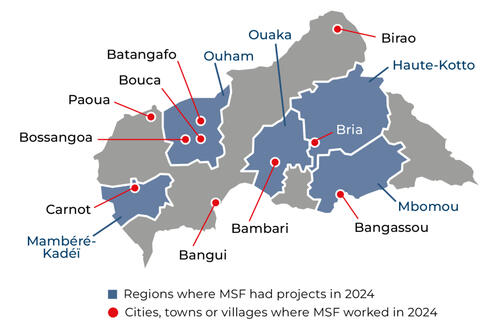
MSF in Central African Republic in 2024
The security situation remains volatile in several regions of Central African Republic (CAR), a country with some of the world’s worst health indicators, and where millions of people have no access to healthcare.

543,600
543,6
324,800
324,8
10,300
10,3
4,820
4,82
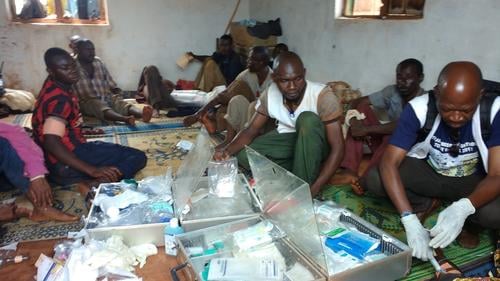
Central African Republic
Update on violence in the east of CAR and MSF response
Project Update
19 May 2017
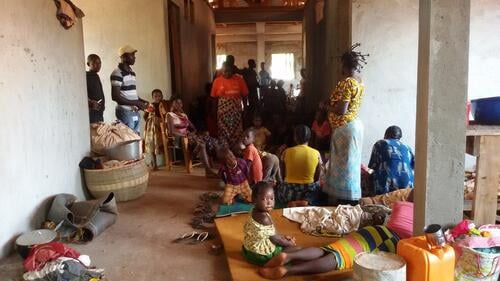
Central African Republic
"The city of Bangassou has turned into a battlefield; we fear the worst for the civilian population"
Voices from the Field
16 May 2017
Central African Republic
MSF calls for a ceasefire in Bangassou to allow for the deployment of urgent medical aid
Press Release
13 May 2017
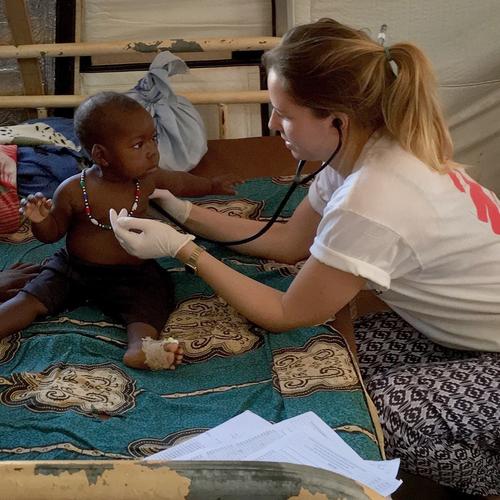
Central African Republic
“Our paediatric hospital had to suddenly function as an adult trauma centre”
Voices from the Field
13 Apr 2017
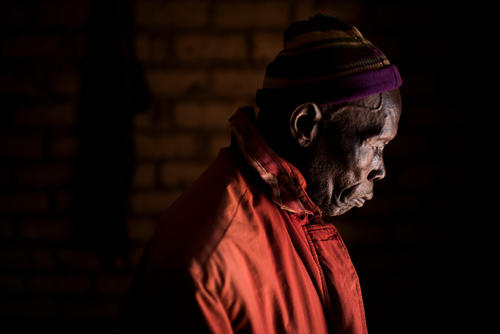
Central African Republic
Civilians pay the price of renewed, brutal fighting
Press Release
13 Apr 2017
Central African Republic
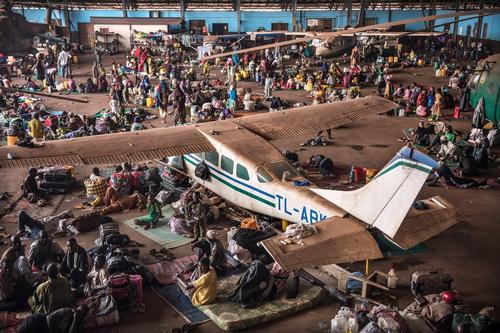
Five reasons to care about the closure of Mpoko camp
Project Update
24 Jan 2017

Central African Republic
MSF distributes food to 10,500 displaced and vulnerable people in the north
Press Release
12 Jan 2017