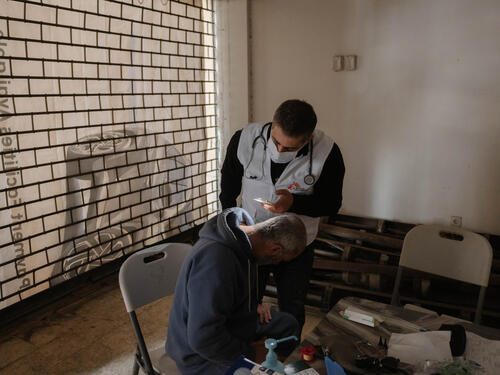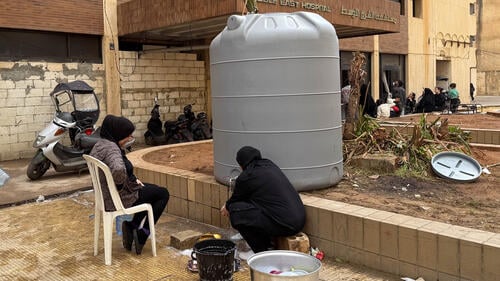
Médecins Sans Frontières (MSF) is supporting communities who have been forcibly displaced by Israeli bombardments and blanket evacuation orders across Lebanon. Through mobile clinics we are providing general healthcare, medications for non-communicable diseases, sexual and reproductive health services, and mental health support.
Access to safe water and sanitation services remains one of the most essential pillars of health and dignity during displacement. Across Lebanon, MSF has been strengthening water and sanitation conditions in shelters to ensure people are able to keep themselves and their living spaces clean, manage waste, and protect their health, privacy and dignity.
Maryam Srour, our communications manager in Lebanon, reflects on her time visiting families living in an abandoned hospital in Beirut that has turned into a temporary shelter. There, daily life is shaped by coping with displacement and difficult living conditions.

Video
Water and sanitation services in shelters in Beirut
I was here in October 2024, during the last escalation of war in Lebanon. At the time, MSF teams were repairing rundown pipes and toilets so that people who had taken refuge inside, many with additional needs, would have access to clean water and safe living conditions.
I didn’t realise until I stepped into the building in March how much I had tried to forget it.
Grey walls. Grey ceilings. Grey floors. The same scenes. The same struggles.
I step into a space stripped of warmth and colour. Puddles of water litter the floors and corners. Rooms with gaping windows are patched over with bits of cloth and cardboard—anything to keep the inevitable cold and rain at bay.
And the sounds. The sounds of water dripping and people coughing greet me through the dilapidated corridors.
This building was once the site of one of the most advanced hospitals in Beirut. My mother tells me it was home to the first MRI machine in the city. My grandmother even sought care here once in 1990.
After years of civil unrest, it was abandoned, left to decay. A building that once represented medical care and recovery, now depicts something else entirely.
A collective shelter, home to nearly 400 people.
Mothers. Elderly people. Patients on dialysis and cancer treatment. Families from different walks of life, brought together by displacement.
No toilets. No running water.
I am here with MSF. Our mobile clinics and different teams visit shelters like this one, responding to the mountain of needs people face.
My colleague, Mohammad Dandash, MSF logistics manager, walks me through the 12-storey building. MSF worked here during the 2024 escalation, clearing grey water and repairing toilets for people with disabilities or additional needs. Following the ceasefire, families returned home.
Mothers. Elderly people. Patients on dialysis and cancer treatment. Families from different walks of life, brought together by displacement.Maryam Srour, MSF communications manager in Lebanon
Sixteen months later, with intensified Israeli bombardment and widespread evacuation orders, more than one million people in Lebanon have been forced from their homes – some for the second or third time.
From floor to floor
The basement is a no-go zone, marred by decades of waste and stagnant water.
On the staircase, an elderly man passes by carrying empty jerrycans. Mohammad tells me that soon this daily climb – up and down, repeatedly – will no longer be necessary. MSF teams have installed 15,000-litre water tanks and are working to restore the piping system to bring clean, reliable water into the building.
We reach the third-floor landing, the grey around me is interrupted by bright bits of clothes hung to dry on lines of rope, and a beige door every few metres. The light is dim, but there are signs of life here. A crooked wheelchair sits idly by a door, its owner nowhere to be seen.
And then, a woman greets me with a smile.
“We have a newborn on this floor. Would you like to see her?”
I return the smile, instinctively, even as something tightens in my chest at the thought of a newborn in a place with the constant sound of dripping water. I follow her into a room marked ‘302’, and my heart sinks.
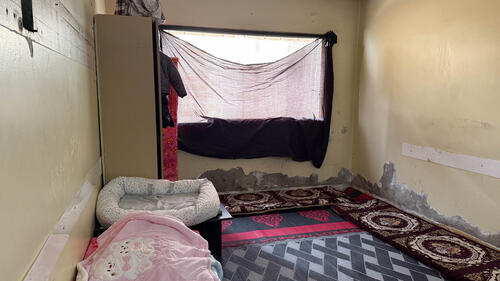
Little Nour lies wrapped in pink. She was born on 16 March, on a night when Israeli airstrikes pounded her former neighbourhood. Her mother remembers the sound of relentless bombardment as she went into labour. A week earlier, the family had fled their home in Beirut’s southern suburbs and taken refuge in this room with a framed opening. A piece of cloth, now a substitute for glass, is attempting to block the wind and rain. Mattresses are stacked in the corner. A worn rug marks the space where shoes must come off.
Her mother is warm and welcoming. “I keep sanitising and cleaning,” she tells me. “I’m almost obsessive about it. She’s so young, and I don’t want her to catch anything.”
Across the hall, Ali, 10 years old, and Abbas, five years old, play quietly. Both were born with cognitive and mobility difficulties. Both need special care.
“Abbas was improving so much with physical and speech therapy,” says Zainab, their aunt. But the war took that away. She and her brother both lost their jobs and incomes. The therapy stopped.
Then came the forced displacement. How can care and recovery continue when daily life revolves around securing basics: flood, clean water and warmth?
“I just want them to have a future,” Zainab says.
“Staying healthy becomes a daily struggle”
Poor water, sanitation, and hygiene are not only a matter of dignity; they are serious public health risks. They increase the likelihood of preventable skin conditions and communicable diseases, particularly among children and those who are already medically vulnerable.
They also reshape daily life in quieter, more insidious ways. Our medical teams have even seen people develop urinary tract infections because they reduce their water intake to avoid having to find a toilet.
“People who were displaced to these places often arrive with nothing, but what makes the situation worse is not having the minimum conditions to live safely,” explains Elena Fernandez, MSF deputy logistics coordinator.
“Without water and sanitation, even staying healthy becomes a daily struggle,” she says.
Across Lebanon, MSF teams are working in 252 shelters like this one to protect people’s health and support the basic need for clean water and sanitation services. So far, they have installed 490 toilets and 160 showers, and set up around 250 sinks and 50 water tanks, helping families access safe water and reduce the risk of disease. To meet daily needs, teams have distributed 1,197 cleaning kits and 15,715 hygiene kits, as well as relief items like blankets and mattresses, while providing 419,127 litres of drinking water and trucking over 19.5 million litres to shelters — supporting thousands of people trying to cope with life in displacement.
Alongside this, mobile clinics reach those otherwise cut off from care, with medical teams treating chronic conditions, providing mental health support, and responding to emergencies triggered by the ongoing violence.
Our work is done in coordination with the Lebanese authorities, supporting and complementing local response efforts to expand access to essential services for displaced communities. But the needs remain immense.
MSF's water and sanitation activities across Lebanon
490
49
15,715
15,715
19,500,000
19,500,
One floor above, I meet Hassana.
The first time I meet her, she is wearing a mask, her eyes heavy. She mistakes me for a member of the logistics team and pulls me aside. “Thank you for working on the toilets,” she says. “I have a special request.”
When Mohammad arrives, she clings to him. The tears she had been holding back spill over.
Hassana was diagnosed with cancer just one week before she was displaced. She was prescribed immediate radiotherapy. After each session, her doctor instructed her to isolate, both for her own safety, and to protect others.
But how can you isolate in a shared shelter? How do you protect others when you share a communal toilet with 40 other people?
“I am ready to die,” she tells me quietly. “But I don’t want to hurt anyone else while I do.”
The second time I meet her, she is different. Lighter. Brighter.
MSF teams have installed a latrine inside her room, helping her continue her treatment safely, with privacy and dignity.
She takes me to meet her two birds, Kiko and Koukou. She smiles describing their reaction when she returned to rescue them.
“They are souls, like my children. How could I leave them behind?”
There is something hard to describe in the way people look at my colleague Mohammad, and others wearing the MSF vest here. They approach the team requesting basics like medical care, hygiene items, diapers. Not with hesitation, rather with smiles and trust.
And I realise that this trust is founded in our presence; on consistency, on showing up and responding, again and again.
As I write down their requests, I hold on to that same belief: that we will continue to respond.
“This will pass,” Hassana tells me. “My illness will pass. This war will pass. Everything will pass, as long as we return home, safe and victorious.”
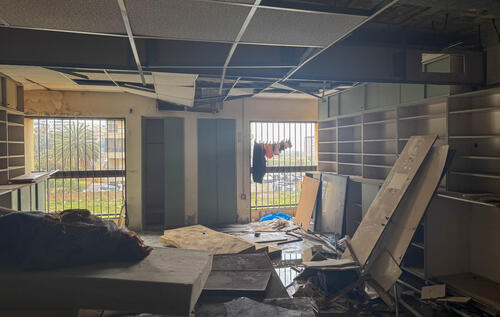
Her words linger as we move through the building, past hundreds of lives suspended in uncertainty.
This shelter is not an exception. Across Lebanon, in schools, tents, and unfinished buildings, thousands of displaced people are living under similar conditions — without reliable access to water, sanitation, and other basic services.
MSF teams are responding in sites like this one across the country, working to restore what has been lost: not only infrastructure, but the minimum conditions for health, dignity, and the possibility of recovery.
Lebanon
Lebanon: Humanitarian scale-up urgently needed after almost two months of devastation
Statement
17 Apr 2026
Lebanon
Lebanon: Testimony from a night of mass casualties in Beirut
Voices from the Field
9 Apr 2026